
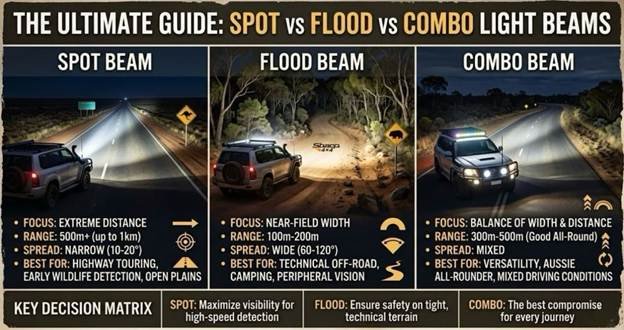
Travelling out of town after dark often feels unique in Australia. Yet danger might wait just around the bend, so one should stay alert. Rural night journeys bring risks like stray animals, sudden kangaroo crossings, and long stretches of dark bitumen. Headlights fitted by manufacturers alone won’t keep trouble away.
Upgrading your front driving lights is absolutely necessary, but it definitely opens up the age-old conversation of spot vs flood vs combo. Learning how the different styles of lights will work at each stage of your journey will help with your setup and safety of touring.
It is important to understand, when contacting a reputable 4WD equipment supplier to invest your hard-earned money, what kind of light will be providing adequate amounts of illumination for your typical travel routes.
The Penetrating Power of Spot Beams
When driving down a straight, open highway in the Red Centre, vision depends on how far ahead you can see. Built for reach, a spot beam pushes light straight ahead in a tight column, cutting deep into the dark as far down the road as it can get.
By having this long-distance beam, you will have the maximum amount of reaction time possible, enabling you to see hazards, wandering stock, or approaching road trains from kilometres away. The light has very little spill out to the sides.
Spot beams are ideal for travelling at high speeds down long stretches of road where you primarily focus on the area ahead of your car’s hood and the sight of distant objects. On the many long-distance drives across motorways and the blacktops, investing in at least one dedicated spotlight for your vehicle is mandatory.
| Best for: | Pros: | Cons: |
| Speedy highway driving, outback terrain, and spotting hazards ahead, like animals. | Exceptional visibility improves safety at high speeds on straight roads. Reduces reaction time. | Limited visibility hinders winding track navigation or close obstacles. |
The Wide Reach of Flood Beams
Conversely, when you come off the highway and hit the winding, corrugated dirt tracks, seeing kilometres ahead becomes much less important than seeing what is hiding in the scrub right next to you. This is where the flood beam truly excels. It spreads the light out wide, illuminating the shoulders of the road, the table drains, and the surrounding bushland.
When weighing up spot vs flood driving lights for tight, twisty Victorian High Country tracks or dense coastal scrub, the flood beam wins every time. It provides a massive field of view at slow speeds, easing navigation of deep ruts and spotting wildlife waiting to dart across your path. The off-road gear retailer with experience will let you know that a broad, sweeping field of vision is important for technical, slow four-wheel driving.
| Best for: | Pros: | Cons: |
| Off-road driving, bush tracks, and campsite setup activities. | Optimal peripheral visibility for hazard detection in tight technical driving. | Limited beam range. Not for speeding. |
The Versatility of Combo Beams
For the vast majority of Australian four-wheel drivers, weekend travel involves a bit of everything. You might spend three hours on the highway before tackling a two-hour winding dirt track just to reach camp. This is precisely why combo beam patterns were invented.
A combo light integrates both spot and flood reflectors or optics into a single, cohesive unit. It gives you that necessary punch of light down the middle of the road while still spilling enough light out to the sides to spot those lurking kangaroos. When looking at an LED light bar beam pattern, a combo setup is often the most popular choice on the market.
It offers the ultimate versatility, ensuring that you have great visibility in the dark regardless of the terrain. If you only have the budget or space for a single light bar, a combo pattern is usually the recommendation you will get from the off-road specialists.
| Best for: | Pros: | Cons: |
| Versatile touring setups for mixed driving conditions without multiple lights. | A balanced, visible, adaptable, and convenient all-in-one solution. | Performance varies by brand/design. May not match dedicated spot or flood beams. |
Tailoring Your Setup for Night Driving
Selecting the perfect lighting setup ultimately comes down to being brutally honest about where and how you drive. A bloke who only drives the Nullarbor needs a very different setup than a family who spends their weekends exploring dense state forests.
Many touring rigs run a pair of round LED driving lights in a hybrid configuration. A common setup involves mounting one dedicated spot on the driver’s side for highway reach and one combo or flood on the passenger side to light up the verge.
This mixed approach brilliantly tackles all the unpredictable challenges of night driving in Australia. Before making a final decision on your layout, it is always worth having a yarn with a trusted off-road equipment supplier. They can help you tailor the beam patterns to your specific bull bar, vehicle model, and travel style.
Other factors that you need to consider include lumens, legal regulations, and weather conditions.
Frequently Asked Questions
Which light pattern is best for avoiding kangaroos on rural roads?
Drivers use combo beams or dedicated flood beams in the dark for spotting wildlife. While spot beams illuminate far ahead, wide beams light up road shoulders, providing crucial peripheral vision to react to kangaroos or other animals appearing suddenly in front.
Can I mix different LED driving lights on my bullbar?
Experienced tourers often use a customised lighting setup, with a spot beam on the driver’s side for long-distance visibility and a combo or flood beam on the passenger side to illuminate the left-hand verge, balancing highway distance and winding track width.
Is an LED light bar beam pattern different from round driving lights?
The key distinction is light distribution. Round driving lights feature larger reflectors, excelling in long-distance beams, while light bars, with a horizontal design, offer wide light spreads. Modern high-end light bars use advanced optics to replicate the reach of round lights while remaining slim.
How far should a long-distance beam actually reach?
High-end lights may claim to reach over two kilometres, but usable light is key for safe night driving. Ideally, for highway speeds, a beam should clearly illuminate 500 to 800 metres ahead. Discuss the “lux” rating at specific distances with suppliers, ensuring the light’s brightness is practical, rather than focusing solely on maximum reach.
Stepping Out Into the Night with Confidence
A solid lighting setup protects everyone who travels with you. If your preference runs to a long-distance spot beam, a broad-coverage flood beam, or a jack-of-all-trades combo beam, what matters most is their ability to face Australia’s remote landscapes. Equipment must be reliable enough to endure extremes without failing where help is hours away. Getting your gear from a local Australian off-road accessories supplier like Sharp 4×4 means you will get products that are guaranteed to handle relentless corrugations, bulldust, and extreme temperatures.
Take the time to think about your off-road adventures and decide between spot vs flood vs combo options. This will help you tackle the darkest outback tracks with renowned confidence.
Disclaimer: This article is for informational purposes only and reflects general opinions on off-road lighting setups. It does not constitute professional, mechanical, or safety advice. Readers should verify local laws, vehicle regulations, and product suitability before making any modifications or purchases. The author and publisher are not responsible for any loss, damage, or injury resulting from the use of this information.
About the Author


John Giddings is an expert in app reviews and guides, helping parents and families understand and use digital tools easily. He writes clear, step-by-step articles on apps like ParentPay, showing how to make payments, stay organized, and get the most out of technology. John’s goal is to make complicated apps simple and safe for everyone to use.